

The Post-Optimization Paradigm
How products & brands evolve beyond frictionless everything

Quick note before you dive in:
Signal Brief is where I track the cultural signals that foreshadow how products and brands, and the relationship people have with them, are changing.
So far, you’ve seen the monthly signals. This is the first time we’re publishing a Report: a more structured synthesis that identifies the fractures those signals point to and the deeper shifts forming underneath the noise.
And for the first time, I asked three strategic thinkers to respond: Davide Colla , Kerensa Ayivor, Cameron Norman. Their role isn’t to operationalize the ideas, but to push them forward: to project implications, pressure-test what’s coming next, and name what these fractures could mean for the systems we’re about to build.
Here we go.
—
THE POST-OPTIMIZATION PARADIGM
We’re moving past “better = faster and smoother” into a world where advantage comes from how well products and brands handle reality, complexity, and emotion.
Most products are already good enough in terms of speed and usability, so optimization is no longer a differentiator.
Synthetic content, agents, and AI personas bend reality so convincingly that ‘what feels real’ now matters as much as ‘what is true.’
After years of frictionless feeds and endless content, users want products that hold depth and feeling, not just make things faster.
Users now demand radical authenticity and expect experiential complexity.
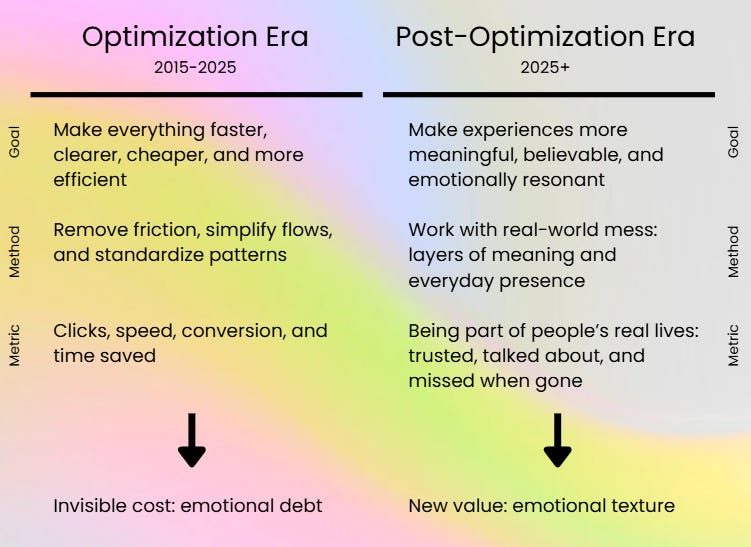
For the last ten years, the tech industry has operated on a single, unquestioned assumption: The user wants to get from A to B as fast as possible.
So we optimized. We smoothed out the friction. We designed interfaces that predicted intent, flattened context, and nudged behavior. We treated the user not as a person to be understood, but as a metric to be converted. And it worked. Until it didn’t.
The era of blind efficiency is over. The cultural signals from the second half of 2025 are screaming one thing: users are no longer looking for the fastest path to a solution. Users are looking for the truest path to a feeling.
We talk a lot about technical debt (the cost of taking shortcuts in code). But we rarely talk about emotional debt as the cost of flattening most human experience into a clickable transaction. That debt is now coming due.
Three ways the Post-Optimization Paradigm shows up:
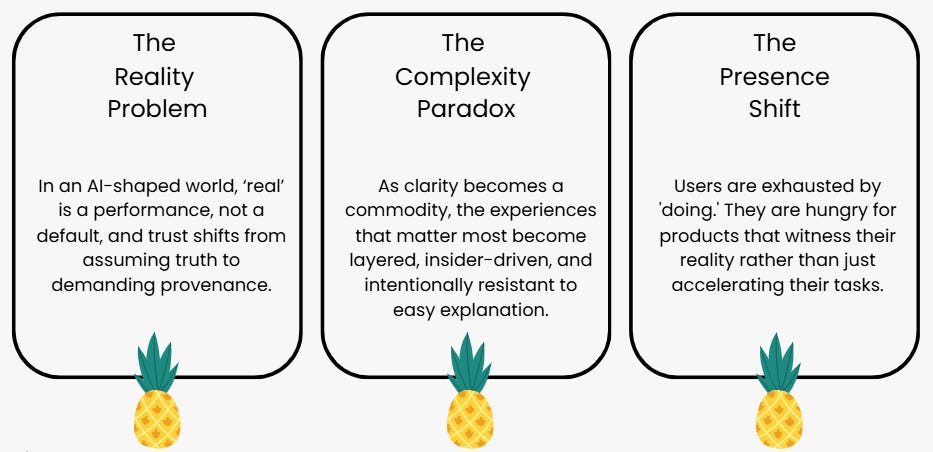
The next generation of products will differentiate on how much reality they can hold.
The smooth, optimized surface of technology is cracking, and what’s bubbling up underneath is messy, complex, and undeniable. The new value isn’t found in speed but lies in texture.
For a decade, frictionless was the gold standard. We stripped away the edges, flattened the context, and polished the experience until it became a smooth exchange. We assumed that if we removed the effort, we would increase the delight. But we were wrong. By removing the friction, we removed the surface area for connection. We created an ecosystem of over-optimized, context-flattened, language-neutral content. In our rush to make things easy, we made them feel empty.
The texture we are seeing now is a reaction to a digital world that has become too smooth to hold on to. All those unresolved, flattened, and numbed-out moments we designed into the system weren’t just efficient. They were costly. The User is dead. Long live the Real Person.
We have reached the limits of the Optimization Paradigm because we have exhausted the emotional limits of users. They are exhausted but still wired, they keep on showing up broken, conflicted... and real. And we need to pay that debt not in time savings but in emotional resonance.
What are we optimising for? Time saved, or life well-lived?
“Technology is not neutral. We’re inside of what we make and it’s inside of us. We’re living in a world of connections and it matters which ones get made and unmade.” Donna J. Haraway, The Cyborg Manifesto
Technology is always the product of ideas about the world and how it needs to change. In the 1960s, Silicon Valley emerged as a cultural powerhouse and embedded one idea deep into technology: time as a resource to be saved or spent.
This idea showed up everywhere. The productivity software of the 1980s literally measured “time saved.” By the 2010s, social media platforms optimised for “engagement time” and notification velocity.
When “optimisation of time” became a key idea for technology, it also became a cultural concept. Saving time was no longer just a functional benefit; it became a proxy for progress. Faster meant better. Smoother meant smarter. Friction signalled failure. Slowness, once associated with care, deliberation, or craft, was reclassified as inefficiency.
Over the last few decades, a reality has formed, and we now live inside its outcomes: speed over depth, ease over friction, clarity over complexity, output over analysis.
People are faster, more connected, and more informed, yet also more exhausted, more fragmented, and less certain than ever. The idea that saving time would lead to better lives doesn’t match our lived experiences.
The new post-optimisation paradigm encodes a different idea. It views time not just as a resource to manage, but as something relational. Where value is created through connection and interaction, and technology nurtures presence rather than simply driving tasks forward.
We are already seeing this shift emerge in technologies that prioritise relevance over speed, presence over interruption, and context over constant optimisation. Value is increasingly created through alignment rather than acceleration. This emerging era keeps optimisation, but asks a different question: What are we optimising for? Time saved, or life well-lived?
FRACTURE 01 - The Reality Problem
We entered the “As-If: era, where product and brand performance are heavily scrutinized. Now, users are no longer just consuming reality; they are auditing it. Authenticity is no longer an aesthetic. It is a chain of custody, in which the key question isn’t “is this true?” but “where did this come from?”
Users have developed a synthetic reflex. They can feel when the labor, care, and human friction have been optimized out of the experience. When AI is used to bypass the messy human work of creativity, you don’t get efficiency. You get cheapness.
When reality is increasingly performed by AI systems, product and brand teams inherit a new kind of work. It’s no longer enough that things technically work. The focus now is on the quality of the performance, how honestly it’s staged, and what the actors are allowed to do.
Upgrade The Performance
When something looks cheap, generic, or emotionally flat, it is read as contempt and extraction, especially in moments meant to feel human. Fast and obvious cost-cutting is now synonymous with “this is synthetic” and “they don’t care.”
Reveal The Staging
In the As-If AI era, things don’t need to be real, only real enough to feel right - transparent UX alongside synthetic UX. Users will accept AI, but they won’t accept not knowing when something is synthetic, staged, or edited after the fact.
Govern The Actors
As AI agents start to post, earn, and gather followers, they stop being tools and become actors you’re responsible for. Governance becomes the product, and you own their cultural and economic impact even if you don’t control the vendor chain.
Reality hasn’t disappeared. But it no longer comes for free.
I don’t experience the reality problem as a theoretical question. I experience it as a recurring tension in my daily work, especially when creating or presenting images that no longer have a clear relationship with something that existed in front of a camera, under a real sky, at a specific moment in time.
For a long time, images worked as proof. Even when heavily edited, they still carried a trace of presence. Someone was there. Something happened. Light touched a surface. That implicit contract shaped not only aesthetics but trust. Today, that contract feels unstable.
Generative images don’t oppose reality. They bypass it. They no longer need presence to feel plausible. And this changes the nature of the questions we ask. Instead of wondering where an image comes from, we start wondering whether that question still matters. That shift feels subtle, but it carries weight.
I notice this most clearly outside professional conversations. Sometimes my five-year-old son looks at the images on my screen and asks, “Is this real?”
There is no theory in that question. Just an intuitive need to understand whether what he sees belongs to the world or to imagination. Hesitating before answering makes me realise how quickly our shared definition of “real” is dissolving.
In commercial creativity, this ambiguity becomes operational. Clients rarely ask whether an image is real. They ask whether it works. As speed increases, so does the responsibility of deciding which realities we construct and circulate. The problem is no longer execution, but judgment.
The reality problem for me is not about resisting new tools. It’s about acknowledging that images no longer guarantee presence, and that this changes how trust is built. Reality becomes a feeling rather than a fact. Authenticity becomes something that must be actively shaped.
Reality hasn’t disappeared. But it no longer comes for free. And that responsibility sits with the people who decide what images enter the world.
FRACTURE 02 - The Complexity Paradox
We optimized for frictionless until the experience slipped completely out of the user’s mind. Now, there is a swing back to the dense, the difficult, and the difficult-to-decode.
Clarity has become a commodity. Now mystery is the new premium.
In a world of smart summaries and AI that explains everything in three bullets, being understood instantly is no longer a flex. It feels cheap. The value is migrating to Insider Systems and experiences that require context, effort, and initiation. Users are rejecting the Universal Universal (designed for everyone, loved by no one) in favor of the Specific Specific (impenetrable to many, essential to a few).
Apps and interfaces are smoother than ever, but the things that actually matter to people are anything but simple. Meaning now comes in layers, in emotionally complex moments, and in small rituals that don’t fully explain themselves. Instead of removing complexity everywhere, the next most loved products are deciding where to keep it and how to hold it.
Design For Layers
Optimizing for universal comprehension as the only goal now flattens meaning. Next-gen products offer more layered experiences: multiple versions for different contexts; a slow entry that demands attention; intentional ambiguity to build ownership.
Center Emitional Complexity
Emotional texture matters as much as technical coherence and is part of the interface. Products that make space for pain, doubt, and unresolved feelings become the ones people value and stay with.
Prioritize Rituals Over Reasons
Participation matters more than explanation. In a culture flooded with explanations and over- optimized feeds, products that support small, insider rituals provide a kind of social glue that can’t be easily copied or decoded.
The language of value
Analyzing the roots of the language we speak can help reconnect meaning to what we say, especially when so much is being said.
Optimization has Latin roots in the term optimus, “the best,” and the 19th-century English concept of the optimist, “a person who tends to expect the best.” The Latin roots of complex mean to intertwine, or to weave or embrace, together. What does it mean to seek the best in conditions of great complexity?
This question speaks to issues of design, culture, and evaluation. Design is what we make (and how), culture is where what we make lives, and evaluation documents the value produced from the meeting of the two. Some place value in knowing the provenance of something, its rarity (or ubiquity), durability, utlity or beauty.
For most of human history, this was correlated with time and effort — the more of each was invested in something, the more valuable it was likely to be. Add in craft (the skill and practice of making things), and you had a trifecta of value we could assess to determine what was best. Craft brought quality you could trust (a slogan many companies claimed to offer their customers). In this context, we could compare things using relatively stable criteria and standards to assess the merit, significance, and worth of what we valued.
A post-optimization paradigm and complexity paradox upends all of this. The signals and trends we see reflect speed, automation, independence, and an environment that is without stable criteria for assessing value.
Value is far more diffuse, situational, temporal, and — arguably — questionable when we lack a sense of provenance, trust, utility, durability, or even beauty. Yet, as creators, curators, and agents of change, we still have choices about how these signals affect the value we create. And it is in the root of evaluation — value — that we might find guidance on how to realize the benefits of using these signals to guide our work and live with the complexity paradox. What is it that we value?
A post-optimization paradigm invites us to (re)connect with our values, define them, and employ them to shape the value we seek to offer. It also invites us to consider how we shape culture, not just react to it. It invites us to consider what it means to intertwine, weave, and embrace those who share these values, and how we can live with complexity as we shape the value we create for a post-optimized world. What this might lead us to are new questions, new contexts, and a new form of optimism.
FRACTURE 03 - The Presence Shift
We have reached the emotional ceiling of the optimization era. Users are exhausted by ‘doing.’ They are hungry for products that witness and acknowledge their reality rather than just accelerating their tasks.
The new relevance is in holding space.
It is no longer enough to solve a problem; products and brands must now share a context. Whether through silence, subtle presence, or shared history, the new value will come from entities that can be with the user—not just work for them—by recognizing how they feel and respecting their experiences.
Classic engagement tactics are hitting a wall. People are overstimulated, always on, and tired of products that keep asking for more from them: more taps, more replies, more performance. Culture is increasingly craving recovery, softness, and undemanding presence.
Design For Permission
If your product lives close to people, trust depends on how easy it is to say “not now.” Make presence something users actively choose, not something they have to fight. Closeness feels safe when users feel fully in control of the terms.
Normalize Gentle Rest
Assume emotional overload is the default and make softness a deliberate pattern, not a lack of ideas. Stillness and blankness should be tied to recovery, reflection, or transition, rather than hiding in neutrality.
Become A Quiet Company
In an over-activated culture, not every interaction has to be a task, a nudge, or a win-back. Design states where your product can witness, listen to, or lightly acknowledge without pushing for action are the ones people actually want around.
Most products are not built for the days I have nothing to give.
Products throw a lot at us every day, even if we don’t register it: prompts, goals, smart suggestions, the occasional “let’s get you back on track.” When life is going smoothly, when I’m rested, I can handle the demand. In those moments, I’m perfectly capable of being a user.
The fracture shows up when I’m not. When I’m exhausted, jetlagged, or coming home from a hard conversation, I still reach for my phone – not to optimize anything - but just to have something familiar in my hand. That’s when a different filter kicks in.
Some products suddenly feel heavier: streaks I’ve broken, messages I haven’t answered, badges I’ve lost by not keeping up. They feel heavier because they are built for activation, not for the days I have nothing to give. So, they greet me with a record of everything I didn’t do. It feels like I’ve permanently lost my right to vanish for a week, being punished for showing up empty-handed, met by a wall of red dots as if the time away automatically counts against me.
Other products behave differently. They don’t make me feel smaller, even on my worst day. They may not do very much in that moment, but they stay and wait instead of insisting on a mood I don’t have, or reminding me of a version of myself I’m not able to be right now. And when I’m ready again, they’re exactly where I left them, as if the relationship mattered more than the streak.
I don’t trust products that sulk when I disappear. I prefer those that save my seat, don’t keep score, and let me drop back in without a lecture. The ones that assume gaps are part of being human, not bugs in the engagement graph. In the long run, those products feel less like systems I’m obliged to maintain and more like places I’m allowed to return to.
In the end, presence is really about how a product handles the user’s absence: whether it quietly holds the door or loudly holds a grudge.
People are done being treated as inputs to be optimized.
AI-driven product agency breaks the loop product design perfected so far: the user decides, the system responds, and the team eliminates friction to improve conversion. When products can initiate, suggest, choose, and act, good design is no longer just about smooth, simple flows. Good design requires judgment: what the system decides to do, when it decides to do it, and how it behaves when the user is tired, uncertain, or absent.
The three fractures signal an important shift: people are done being treated as inputs to be optimized. As users, we no longer just evaluate outcomes. We evaluate what a product knows about us; its intent, its care, and whether it deserves our trust.
The endgame isn’t just building more intelligent products but more responsible ones, which gives design a new job: shaping systems that can take initiative without losing trust, depth, or humanity.
Thanks for reading.
You can download the report here.
Thank you for pulling on the emotional debt thread.
That “surface area for connection” point is exactly the dangerous trap: when we optimize away friction, we often end up optimizing away the moments when a product can show care, restraint, or even simple acknowledgment.
And yes to “apps that punish absence.” That’s one of the clearest signals of the Presence Shift: the product assumes constant user performance, and when the user can’t comply, it turns into guilt, streak loss, nagging, or decay. The “quiet company” examples are compelling precisely because they treat absence as information, not failure.
Re: texture vs smoothness, I’m with you. It’s not “make things harder,” it’s “stop sanding off the human.” Teams that internalize that will build products people can actually stay with.
I appreciate you taking the time to articulate this so clearly.